The ownership bar is sourced to Michigan’s Business Corporation Act,
MCL 450.1284(1). Michigan health care counsel has reviewed this reading and confirmed it verbally; written confirmation has been requested and will be cited here when it arrives. The requirement for a physician, shown dashed above, comes from a different document and is now sourced. BCBSM’s
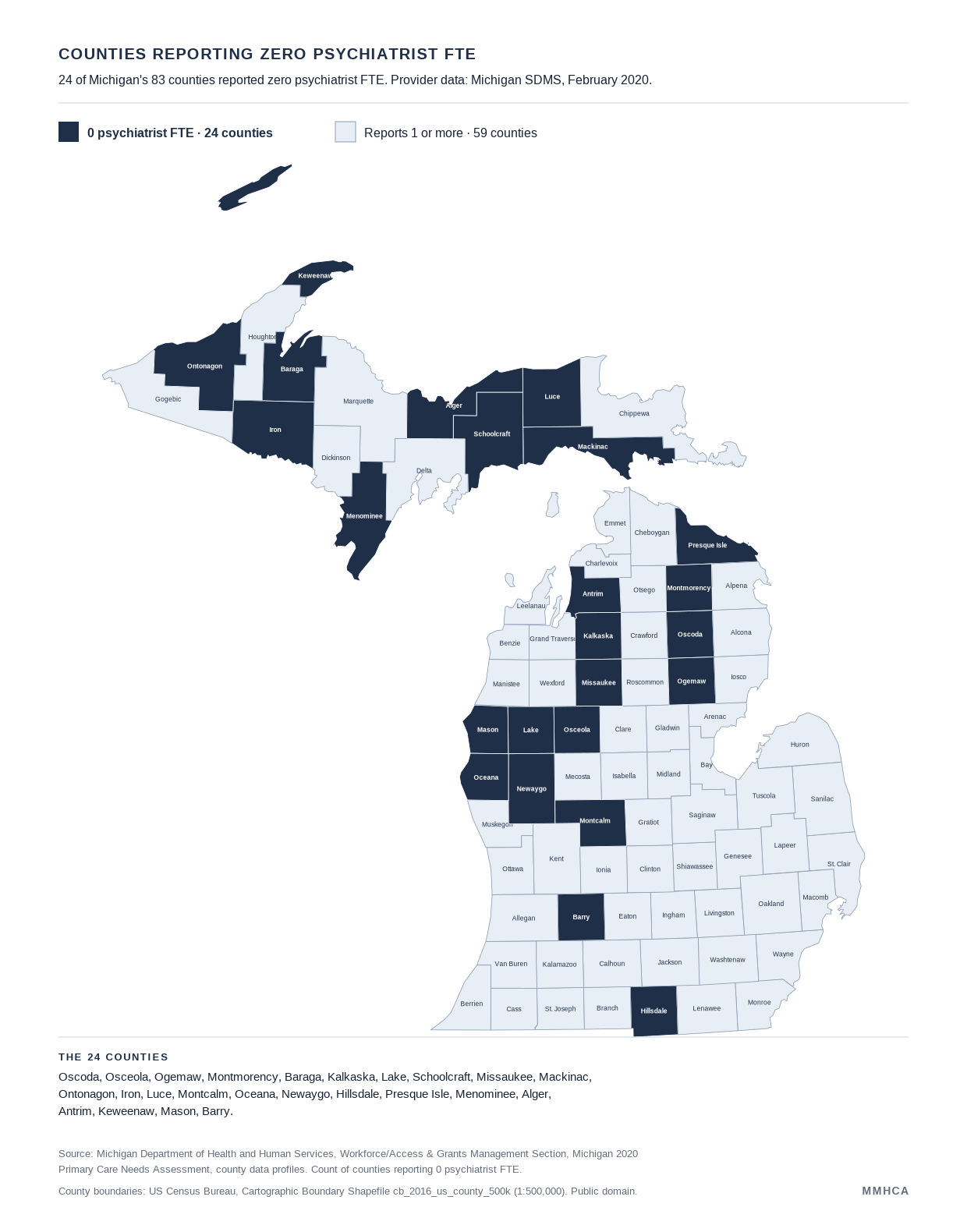
Clinical program requirements for behavioral health outpatient psychiatric care facility, revised September 2026, requires a participating OPC to maintain a core multidisciplinary staff that includes “a board-certified or board-eligible psychiatrist that is enrolled with BCBSM/BCN”; a licensed psychologist, or a limited licensed psychologist “with a supervisory or consulting licensed psychologist, or LP contractual relationship”; and “a Licensed Master’s Social Worker, Licensed Professional Counselor, or Licensed Marriage and Family Therapist.” Core staff may be “contracted/consultative or full/part-time employees.” In the counties BCBSM designates as Rural, Micro or CEAC, listed in the document’s appendix, the psychiatrist seat may instead be filled by “an enrolled psychiatric mental health nurse practitioner, board certified (PMHNP-BC)” who “formally has a collaborative relationship contract in place with a board-certified or board eligible psychiatrist” enrolled with BCBSM/BCN. On the psychiatrist’s presence, the document no longer speaks of regularly scheduled hours. It calls for involvement by a psychiatrist or PMHNP-BC “who may or may not be the designated clinical lead,” and adds: “Ideally, this includes routine times interacting with the facility, or a supervised designee available for emergency consultation with the facility by any communication method within two hours.” BCBSM announced these staffing changes in a
provider alert dated October 14, 2026. The incident-to policy itself does not tell anyone to hire a psychiatrist; it points to facility-based settings, and the staffing requirement lives in the OPC standards. Those standards also require full accreditation of each facility site, a comprehensive range of services, emergency services available on a 24-hour basis, and approval of each facility location before it can bill, so adding a psychiatrist alone does not make a practice an OPC. Since the October 14, 2026 alert, satellite locations in the Rural, Micro and CEAC counties no longer need separate accreditation “unless dictated by an accrediting body”; a central accredited OPC site must maintain the procedures and protocols for them. The same rule appears in both statutes:
MCL 450.1284(1) for professional corporations and
MCL 450.4904(2) for professional limited liability companies, so the position does not turn on which form the practice takes. Michigan does allow some mixed-license professional entities, but the exception at
MCL 450.4904(3) and (4) reaches only chiropractic, medicine, osteopathic medicine, podiatric medicine and physician’s assistants. Counseling is not among them.